The demands on foundries are increasing: reduced resource consumption, consistent molding sand quality, higher sand reuse rates, and lower emissions. This is precisely where molding sand preparation under vacuum with vacuum mixing and cooling comes into play.
The European BAT conclusions for forges and foundries explicitly cite the recycling of clay-bonded sand through vacuum mixing and cooling as the best available technology. For foundries using green sand and clay-bonded molding systems, this sends a strong signal: the quality of sand preparation is becoming a decisive factor for environmental performance, process reliability, and economic efficiency.
Eirich provides the right technology for this: Eirich EvacTherm. High-performance intensive mixers and complete systems for molding sand preparation—from feeding and moistening through intensive mixing to cooling and quality control.
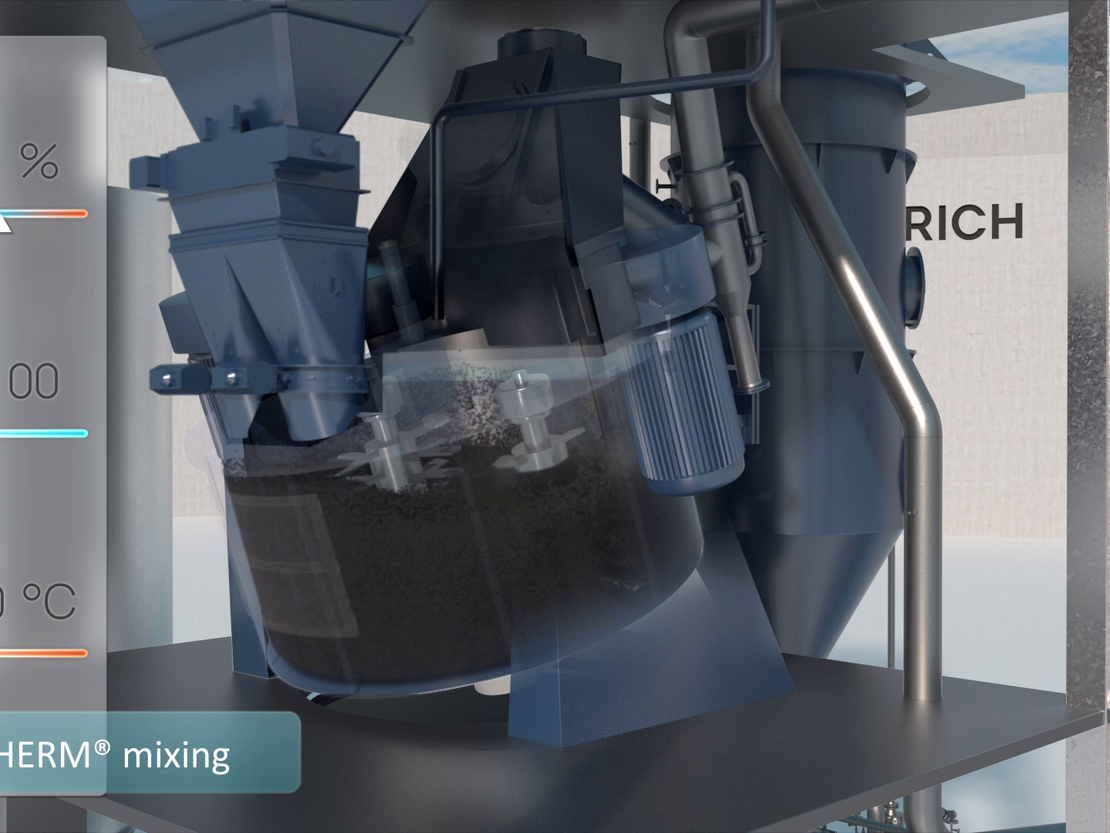
Whereas the air cooling process requires three separate process steps—cooling, mixing, and activating the bentonite’s binding forces—the EVACTHERM® molding sand mixer accomplishes all of this in a single step: Both the cooling process and the activation of the bentonite’s binding forces are integrated into the mixing process.
Why Vacuum Mixing and Cooling Are Becoming More Important for Foundries
Foundries face a dual challenge: They must ensure reliable molding material quality while simultaneously reducing resource consumption, emissions, and waste. The sand circulation plays a central role in this. The more stable and efficient the preparation of used sand is, the more effectively new sand consumption, scrap risks, and process fluctuations can be reduced.
The European Union BAT conclusions address precisely this point. They describe sand reuse as an important environmental performance factor and specify high BAT-associated environmental performance values for sand reuse in foundries. This makes it clear: Modern molding sand preparation is not a secondary process. It is a key lever for sustainable and cost effective foundry production.
The Principle: Mixing and Cooling in a Single Process Step
Vacuum mixing and cooling combine two key process steps: the intensive homogenization of the molding material and controlled cooling. The sand mixer operates under reduced pressure. This allows water to undergo vaporization in a controlled manner, thereby removing heat from the sand.
The result is particularly effective molding material preparation: The sand is intensively mixed, uniformly conditioned, and reliably set to the required temperature and moisture content. This combination is especially critical for clay-bonded molding materials, because water, clay, additives, and sand must interact within a narrow process window.
What the EU BAT Conclusions Say
The European BAT conclusions for forges and foundries explicitly cite the preparation of clay-bonded sand through vacuum mixing and cooling as a technique within the framework of best available techniques.
This statement is relevant in two ways:
First, vacuum mixing and cooling are mentioned in BAT 18 in connection with reducing the consumption of new sand and minimizing the generation of spent sand. Second, the same technique is listed in BAT 25 in connection with preventing or reducing air emissions from mold production using clay-bonded sand.
For foundry operating companies, this means that anyone processing clay-bonded sand should view molding material preparation not only from the perspectives of quality and cost, but also as a component part of their environmental and permitting strategy.
EIRICH technology for Modern Molding Sand Preparation
Eirich has decades of experience in processing demanding raw materials and bulk materials. In the foundry industry, Eirich intensive mixers and processing systems are known for high mixing quality, rugged systems engineering, and reproducible process control.
In molding sand preparation, EIRICH technology performs key functions:
Mixing: intensive homogenization of sand, bentonite, water, additives, and reclaimed sand.
Cooling: precise temperature control during the process.
Moistening: controlled setting of the molding material’s moisture content.
Feeding: accurate addition of binders and additives.
Conditioning: preparation of the sand to ensure stable molding properties.
Process control: Reproducible processes as the basis for consistent quality.
In this way, Eirich systems address key points that are also mentioned in the BAT conclusions for optimized green sand preparation: cooling, addition of binders and additives, moistening, mixing, and quality control.
Benefits for Foundries Through Consistent Molding Sand Quality
Reliable molding material preparation ensures uniform moisture content, temperature, and homogeneity. This supports consistent molding properties and reduces process fluctuations in production.
Higher Sand Reuse Rate
The BAT conclusions set high expectations for sand reuse. A high-performance preparation process helps maintain a stable sand circulation and reduce the need for new sand.
Lower Resource Consumption
When used sand can be reliably prepared and reused, the consumption of new sand decreases. At the same time, this reduces the burden on transportation, storage, and disposal.
Contribution to Emission Reduction
Vacuum mixing and cooling are also mentioned in the BAT document in connection with the reduction of emissions from mold production. Thus, the technology offers a solid foundation for addressing environmental and permitting issues.
Greater Process Reliability
A controlled mixing and cooling process creates reproducible conditions. This is particularly important when operating molding material systems with a high proportion of return sand, varying inlet temperatures, or fluctuating material properties.
For which applications is EIRICH molding sand preparation suitable?
Eirich EvacTherm systems are suitable for foundries that wish to perform the preparation of clay-bonded molding materials or green sand reliably. Typical areas of application include:
- Cast iron foundries
- Steel foundries
- Non-ferrous metal foundries
- Automotive suppliers
- Constructional engineering foundries
- Manual molding shops and automated molding lines
- Upgrading existing sand preparation systems
- New systems with a focus on sand reuse and process reliability
Planning in accordance with BAT—with EIRICH as your technology partner
The BAT conclusions do not name any manufacturers or brands. Therefore, what matters is not the name of a machine, but whether a system concept fulfills the required technical and environmental functions.
Eirich supports foundries in developing modern molding sand preparation systems—from analyzing the existing sand circulation through tests and process evaluation to integrating suitable mixing and preparation technology.
The result is a solution tailored to your production needs: technically robust, process-reliable, and compatible with current demands for resource efficiency, sand reuse, and environmental performance.
Talk to us about your molding sand preparation
Whether it’s upgrading, capacity expansion, or a new system: Together, we’ll measure how your molding sand preparation can be improved both technically and in terms of economic efficiency.
Our experts will work with you to determine which solution is the most advisable for your sand circulation, your molding line, and your quality requirements.
FAQ
Is vacuum mixing of molding sand a Best Available Technique (BAT)?
The European Union BAT conclusions for forging and foundries explicitly list the preparation of clay-bonded sand via vacuum mixing and cooling as a Best Available Technique. The technology is cited both in the context of sand reuse and in connection with reducing emissions from mold production.
What is the advantage of vacuum mixing and cooling for clay-bonded sand?
During vacuum mixing, the molding material is intensively homogenized and simultaneously cooled through controlled water evaporation. This allows temperature, moisture content, and mixing quality to be reliably set.
What role does sand reuse play in the BAT conclusions?
Sand reuse is an important environmental performance factor. The document cites BAT-associated environmental performance values of over 90 percent for cast iron foundries, over 80 percent for steel foundries, and over 90 percent for non-ferrous metal foundries, provided the respective requirements are met.
Does the European Union BAT document mention EIRICH?
No. The document does not name any manufacturers. It describes technologies and requirements. However, Eirich offers molding sand preparation systems that address key functions mentioned in the document: mixing, cooling, moistening, feeding, process control, and quality management.
For which foundries is the technology relevant?
The technology is particularly relevant for foundries that use clay-bonded sand or green sand and wish to improve their sand reuse, molding material quality, and process reliability.